
Do you need a transmission oil cooler

DRIVING/TOWING – TOWING
There are literally hundreds of websites and videos from companies telling you how to fit the after-market transmission oil coolers they make, but do you need one, we’ve been asked?
OK. You have the 4WD tow vehicle and you have the camper trailer, caravan or boat you’ve been towing – or, you’re considering buying such vehicles. Either way, you’ve been hit with a barrage of essentials you need to fit, to make your towing combination bush capable.
If you’ve read all the articles we’ve put in this Towing section of the OTA website you’ll know already that we consider that the towing ratings given to nearly all 4WDs by their makers are excessive. Competition is fierce in the new-4WD world and vehicle makers are under great pressure to rate all their 4WDs at 3500kg towing capacity, with a corresponding 350kg ball weight limit.
We have stated in several of our articles that we disagree with these ratings and we don’t need to repeat these well-researched findings here. The entire 4WD trailer-towing legality structure in Australia needs a thorough overhaul, having grown from the days of the simple, unbraked box trailer to today’s monstrous caravans and boat trailers.
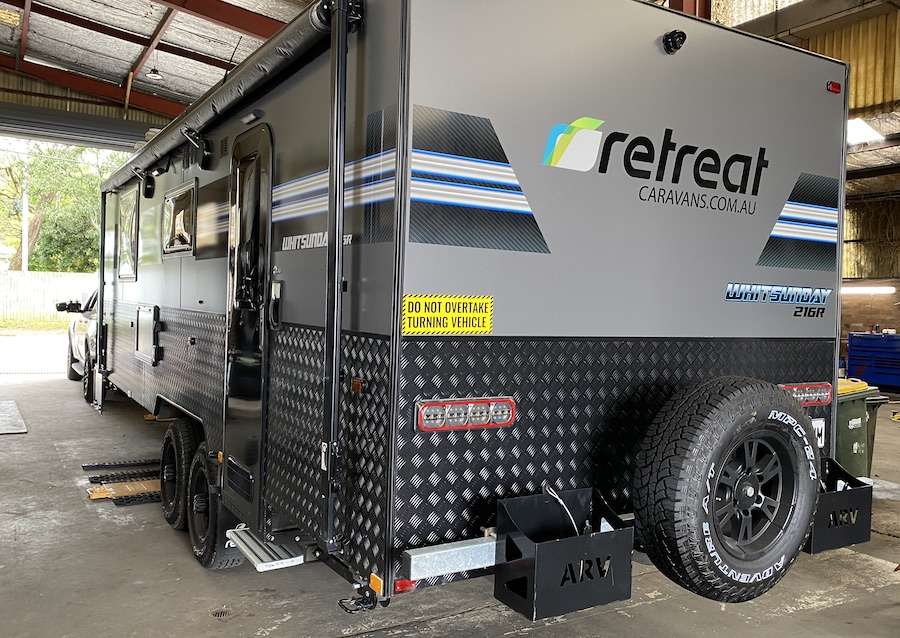
So, to assess whether you need an after-market transmission oil cooler, let’s look at what our many years of bush-travel experience – including heavy truck driving, up to road train size – tell us you should be contemplating.
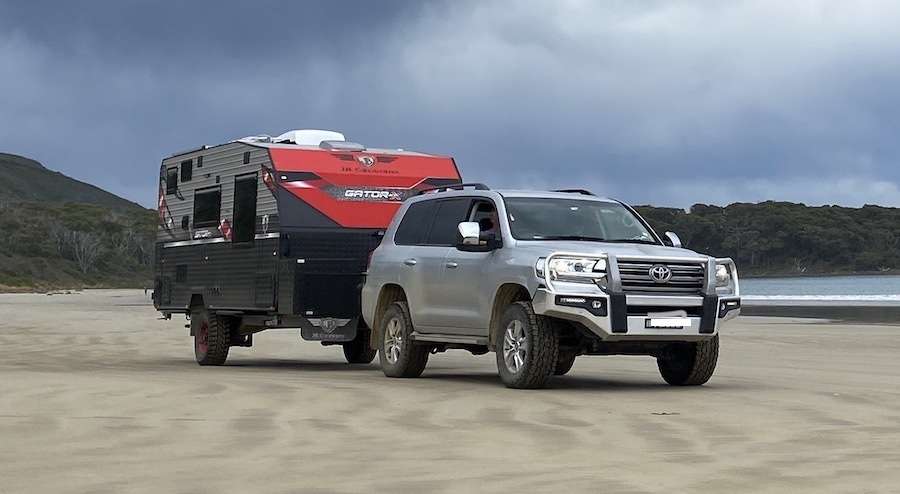
For most 4WD utes and wagons we don’t think you should be towing anything heavier than three tonnes – preferably only 2.5t – and with a ball weight that doesn’t exceed 150-200kg. (That ball load can be achieved by using weight distribution bars if the 4WD maker allows it.)
If you have a Yank ute, you could lift the van weight to 3.5 tonnes and up to, but preferably less than, 300kg ball weight.
OK, next step is assessing the towing vehicle itself. Most people fit a ‘roo bar and driving lights and it’s important to note that these additions can restrict airflow through the engine coolant radiator and the transmission oil cooler that’s already fitted as standard to 4WDs that are rated for maximum towing capacity.
A front-mounted winch can sometimes reduce airflow into the engine bay.
Mesh bug screens also can cause airflow restrictions, unless the gauge of the mesh is maker-approved.
It’s important to ensure that airflow isn’t restricted by this external additional equipment.

Now, let’s consider powertrain modifications. Many people fit after-market engine management chips, or have their ECUs remapped, to make their engines produce more power and torque. We’ve written about the hazards of this practice in our Modifications – Powertrain section.
Performance enhancements usually cause an increase in engine coolant and exhaust plumbing temperature and that raises the under bonnet ambient, reducing the effectiveness of the coolant radiator and the factory-fitted transmission oil cooler.
Another popular mod that is well-promoted on the internet is remapping transmission shift patterns and, while we’ve seen positive results from some applications, that process can also cause an increase in transmission oil temperature.
A larger engine intercooler than standard can also restrict airflow through the coolant radiator.
In a piece of delicious irony, a front-mounted additional transmission oil cooler can also restrict engine bay airflow!

Sure, some after-market, fan-boosted transmission oil cooler kits mount under the vehicle, or ahead of a front wheel, where they don’t restrict engine bay airflow. However, they’re vulnerable to trail damage and animal or flying-stone strikes in these positions and any damage to the cooler core or fittings can cause a transmission oil leak that will fry your gearbox.
Cooler isn’t necessarily better
 Col Voss chart
On the subject of transmission oil temperature, the popular concept of ‘cooler is better’ is simply wrong. As with engine oil, transmission fluid has a designed operating range that’s most commonly in the 90-105o C zone: above that is bad and, to many folk’s surprise, below it is just as bad.
As with engine oil, transmission oil needs to be hot, so the all the various components in the transmission are operating at their functional design temperature – as is the case inside your engine. Modern oils have been developed at great R&D expense to function optimally at these temperatures and that’s why your 4WD’s standard transmission oil cooler flow rate is controlled by a thermostat.
Oil that’s too cold is sluggish and doesn’t lubricate well; oil that’s too hot starts to break down. Powertrain oil should be operated like Goldilock’s Porridge: ‘not too cold; not too hot; just right’.
We think you can see where we’re going with this. We’ve tow-tested most previous and current-model 4WDs with trailers in the 2.2-3.0 tonnes range and had no issues with transmission oil temperatures. These were stock-standard machines, pulling what we consider sensible towed weights and ambients ranged from freezing to 40o +C.
We’ve never had a single issue of excessive transmission oil temperature with any of these vehicles – over the past 50 years.
Fluid maintennace
Despite what many vehicle and transmission makers say, auto box fluid needs regular changing, just like any lubricant. That’s even more the case for the transmissions in 4WDs that tow heavy trailers. Hard work and age affect all of us!
No 4WD manufacturer makes its own automatic transmissions that come from companies that include Borg-Warner, ZF, Aisin and Allison.
There’s pressure on vehicle makers to have capped-price servicing these days and minimising that cost is vital, so little wonder some ‘short cuts’ are taken. Among those is the current practice of labelling auto boxes as ‘sealed for life’. Most of these have no drain plug and no easily serviceable filter.
However, that ‘lifetime’ definition is open to interpretation. In their own tech data, most auto box makers stipulate fluid change intervals that vary from 100,000km to 160,000km. However, some vehicle manuals contradict the policy of transmission makers by stating that fluid changes are necessary only when there’s some owner-reported issue with a transmission.
Our suggestion for 4WD owners who tow regularly is to have their transmission fluid and filter changed at least every 100,000km. In the case of sealed transmissions that are not easily serviced, the cheapest way to drain fluid is to suck it out the filler hole! Because the filter is usually part of the gearbox sump it’s an expensive replacement, but oil analysis can determine of there’s excessive wear material in the drained oil.
Fixes for overheating

Let’s say you do have a transmission temperature problem with a bog-standard 4WD that’s towing legally – with weighbridge dockets to prove it – but the transmission temperature warning light comes on.
Make sure that coolant radiator, intercooler, oil cooler and aircon heat exchangers are clean.
Try reducing speed: particularly on steep hills in very hot weather.
Don’t ‘lug’ the engine: downshift manually to increase engine water- and oil-pump, and transmission oil-pump speeds.
Try reducing the weight in your 4WD and towed trailer.
Have the transmission fluid changed and make sure that’s a more frequent service job, if you tow regularly. Have the radiator fan(s) checked for correct operation.
Still a problem? Talk to your dealer, secure in the knowledge that your warranty is unaffected.
However, if you’ve fitted over-sized tyres; fiddled with the engine fuel mapping; put a lock-up kit on the transmission; mounted an after-market intercooler; or added an after-market transmission oil cooler – you can kiss your warranty claim goodbye.
Advertisements
