
Driving an automatic-transmission 4WD correctly

DRIVING/TOWING – 4WD DRIVING SKILLS
Chances are your 4WD ute or wagon has an automatic transmission and everyone knows how to drive an auto, don’t they? Maybe, but maybe not…
 Aisin eight-speed auto
Nearly everyone gets their driving licence these days in an automatic-transmission vehicle: even heavy truck drivers. (It’s now a mark of distinction for a young heavy truck driver who can handle a manual, non-synchro, Roadranger truck transmission.)
We don’t want to bore you with over-technical explanations of how an auto box works, but a driver needs to know that an auto gearbox has progressive ratios that are automatically selected to keep the engine in its optimal operating rev band. It’s the same process as with a manual transmission, but the ‘slush box’ does all the work.
A bonus with an automatic transmission is a fluid coupling connecting the engine to the box and inside this coupling is a ‘stator’ that multiplies engine torque when it comes under load.
As well, an auto box has a lock-up clutch that can stop that fluid coupling ‘slippage’ when the box doesn’t need to multiply engine torque. That way, an auto 4WD can have fuel consumption similar to a manual 4WD’s.
 Torque converter fluid flow under acceleration
You can tell when an auto box is operating in lock-up mode by watching the engine rev counter. When you back off the go-pedal at cruising speed you’ll see that the rev counter needle drops a little and the engine note changes. If you press a little harder on the go-pedal you’ll notice that the engine revs rise sightly and the tacho needle goes up a little, as the fluid coupling re-engages. That lock-up clutch disengagement is followed by a downshift in the transmission if you press harder on the accelerator.
Modern 4WD automatics have between five and 10 progressive ratios, and electronic control between engine and transmission ensures that most shifts are done automatically and imperceptibly. If the box is left to its own devices that’s pretty much seamless, but manual control is also provided, either by a shift of the transmission selector, or by ‘paddle’ shifters on the steering column.
Using these manual ratio selectors needs to be done with care.

Let’s look at the situation where the 4WD is on-road, but running down a steep grade. The driver wants to use some engine braking to help control downhill speed and so selects a lower-speed ratio. If the engine and transmission electronic control units (ECUs) assess that the shift won’t stress the box or the engine the driver’s wishes are then complied with. If the ECUs don’t like the selection the shift request is ignored.

However, after that ratio has been selected and the grade steepens, the engine revs may rise excessively. Most ECUs will then override the driver’s choice and automatically upshift, but the higher-rev period doesn’t do the powertrain any good.
Another common driving habit we’ve corrected in some of our driver training sessions is the use of the transmission – not the brakes – to slow the vehicle. Using the transmission to ‘hold’ downhill speed as we’ve described above is OK, but using the transmission selector to ‘brake’ the vehicle causes a great deal of stress on the box. The correct procedure is to brake first, to the desired speed, then select the appropriate ratio to ‘hold’ the vehicle at that downhill speed.
Auto towing

Both the above situations become even more hazardous to powertrain life if the 4WD is towing. It’s very easy to over-rev the engine when up to eight tonnes of tow vehicle and trailer is pushing the rig downhill. Expecting the box and the engine to work as a ‘brake’ pulling back the speed of a heavy towing combination is asking for trouble.
The key points: don’t neglect some downhill foot braking to help control speed on grades and never use the transmission selector as a ‘brake lever’ to reduce speed.
Towing with an automatic transmission is generally easier for inexperienced drivers, because the box chooses the ideal ratio to suit the prevailing road conditions. However, there’s no law that says you have to tow a large caravan at maximum legal speed. Stick to the inside lane on four-lane roads; get out of the way of faster vehicles – including heavy trucks – and drive at a comfortable speed. We’ve spelt out safe towing in our Driving/Towing section.
it’s our opinion that the towing ratings given to nearly all 4WD utes and wagons are too high. A caravan tipping the scales at 3.5 tonnes and with a ball weight of 350kg belongs behind a Yank ute (RAM, Chevy, Tundra or Ford F) or a LandCruiser 70 Series. Check our story on torque converter lockup kits.

At OTA we think that the numerous well-publicised issues with 4WD auto transmissions overheating are caused primarily by heavy trailers. Also, 4WD forums are full of recommendations to fit oil coolers to towing 4WD auto boxes, to eliminate perceived over-temperature crises, but many 4WD autos already have factory-fitted transmission oil coolers.
If you need additional cooling then there’s obviously something else going on: too much weight, or too much speed …or both.
Off-road auto driving

An automatic transmission is a boon in off-road situations, because, when left to its own devices, the box’s ECU selects the ideal ratio for current driving conditions. That ratio lets the engine operate with an ideal blend of power and torque.
When the grade changes and the driver pushes harder on the go-pedal the box often downshifts to a lower-speed gear. During this change the flow of power is maintained by the nature of the ‘power-shift’ transmission design. When necessary, the torque converter slips out of lock-up and multiplies the available engine torque by a factor of at least two to one.
So, in most off-road situations where the vehicle can operate in high range it’s safe to leave the gear selector in ‘D’. The same engine braking protocols as we’ve discussed for on-road situations apply: not using the box as a tool to reduce speed.
When it’s time for low-range operation, the box can still be left in ‘D’ for most situations, but for extreme conditions it’s sometimes better to select a suitable ratio manually. Traction can also be enhanced by use of the terrain programs and selectable diff locks that some 4WDs have.
Older 4WDs have powerful engine braking for very steep descent speed control and that’s maximised by manually selecting first gear. Modern engines lack that compression braking, so speed needs to be regulated, when engine braking is insufficient, by engaging Hill Descent Control that applies selective wheel braking.

An automatic 4WD operating in low range and ‘D’ in soft sand conditions can achieve optimal momentum without the high engine revs that can provoke wheel spin. However, there is a risk of overheating the torque converter, because of excessive ‘slip’ in this fluid coupling.
Fluid coupling ‘slip’ can be minimised by manually selecting a ratio that allows sufficient speed, without wheelspin and stops the lock-up clutch disengaging.
The effects of vehicle modifications
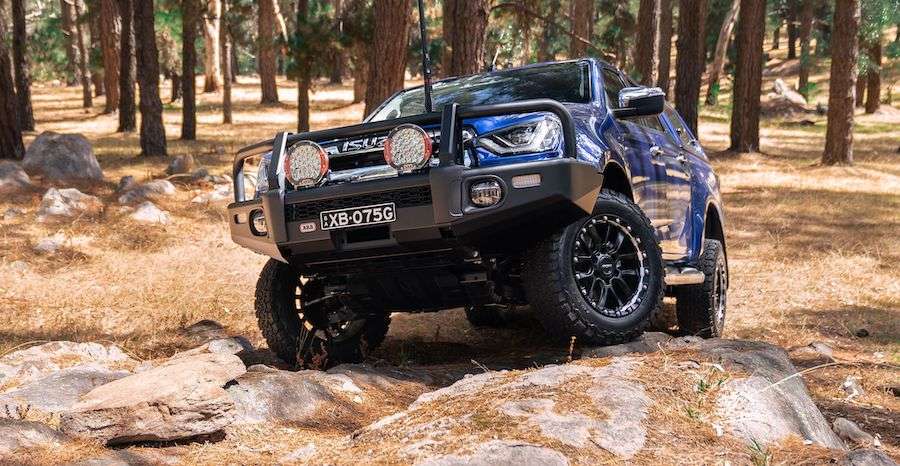
Fitting larger-diameter tyres to a 4WD that has an auto box may seem like an innocent enough modification, but the increased rolling radius means fewer tyre rotations per kilometre for a given road speed and that conflicts with the factory-programmed ratio pattern in the auto box. (Larger-diameter tyres also adversely affect wheel-braking power, but that’s a separate issue we’ve covered in the Wheels & Tyres section.)
‘Chipping’ or re-mapping a 4WD’s diesel engine will change its peak power and torque curves, so the transmission shift programming will be incorrect. (Any alteration to a 4WD’s injection system will void its warranty and emissions compliance, but that’s also a separate story we’ve covered, in Powertrain Modifications.)
Factory-set ratio shift points and ratio selection will be wrong with larger tyres and a more potent engine, so transmission re-programming may be necessary.
So, in summary, driving an automatic-transmission 4WD is easier than driving a manual-box 4WD, but there are still some procedures that should be followed, in the interests of safety and mechanical longevity.
Advertisements
