
Ford Ranger and Raptor

BUYERS GUIDE – UTES & CAB CHASSIS MEDIUM
The Ranger Mk II model was released in August 2015 and updated every year since. The 2023 model was released in mid-2022, upgraded in early 2024 and a PHEV was released in mid-2025. A 2026 Super Duty model is planned.

In late November 2021 Ford previewed the forthcoming 2023MY Ranger. Billed as ‘all new’, of course it wasn’t.
The Next-Generation Ranger project was led by Ford’s Product Development Centre in Australia and the new ute was put through one of the most exhaustive global testing schedules Ford has developed.
FULL DETAILS: Ford Ranger Super Duty
Fortunately, that testing produced better results than last time, when the Ranger was plagued by engine and transmission problems.

Speaking of the Ranger powertrain, the carried-over two-litre diesel that’s shared with the Ford Transit remained for 2023, in single-turbo 125kW/405Nm or twin-turbo 154kW/600Nm guises and the old Land Rover, three-litre V6 turbo-diesel replacesd the Ford-Mazda 3.2-litre, five-cylinder diesel that was discontinued.
The V6 started life as a 2.7-litre Land Rover/Peugeot diesel that powered the 2004 Discovery 3. Later, when Ford owned Jaguar Land Rover, that engine powered the Ford Territory, before being enlarged to three-litre capacity for later Discoverys.
In the Ranger, the re-purposed V6 had figures of 184kW/600Nm.
At OTA, we’re not convinced about the durability of this engine, following oil starvation and crankshaft failures with early models. In April 2025 a recall was issued for this engine, following failures of the left-side camshaft drive sprocket.
Ranger transmissions for 2023MY included Ford’s upgraded 10-speed and six-speed automatics. We hoped the 10-speed upgrade was significant, because the first iteration of the 10R80 transmission was a repetitional disaster for Ford, being the subject of multiple class actions.
The latest version of the Ranger platform had a wheelbase that’s 50mm longer, because the front wheels were moved forward by that much, to improve the approach angle. The front and rear wheel tracks were also increased by 50mm, allowing for a larger engine bay, outboard rear shock absorbers and a wider cargo tub.
The larger engine bay provided more room for a hybrid electric powertrain that’s due in 2025, but more on that later in this report.
We suspect the wider tub was dictated by VW, which shared the Ranger platform from 2022 onwards and obviously wanted to maintain the current Amarok’s pallet-accommodating cargo area.
Customer input was key to developing the Ranger’s new look, Ford claimed. The company conducted more than 5000 interviews and dozens of customer workshops, to understand how customers used their utes and what they expected in the Next-Generation Ranger.
One input from that forum was a footstep integrated into each rear lower panel, to improve access to the tub.
For the first time, some Ford Rangers had LED headlights and some versions got a variable-high-beam function.
The carry-over electronic shift-on-the-fly, part-time 4WD system was retained for most Ranger 2023MY models, but a selectable full-time 4×4 system was available as well. We suspect that’s another VW initiative, because it’s been a feature of some Amarok models for years.

The Ranger interior was dominated by a large 255mm (10.1-inch) or 300mm (12-inch) touchscreen in the centre stack. It complemented a fully digital instrument panel and was loaded with Ford’s latest SYNC4 system, with voice-activated communications, entertainment and information.
Additionally, there was a factory-fitted modem, allowing connectivity on the go when linked with the FordPass™ app, so customers could stay connected. FordPass incorporates Remote Start, Vehicle Status Check and Remote Lock and Unlock functions, via a mobile device.
Many controls were moved from the dash and centre console to displays on the SYNC4 screen.
The screen was linked to a 360-degree camera on some model grades. There was also an exterior, LED zone-lighting system and under-rail tub lighting on some models.

A short-throw ‘e-shifter’ was another quoted example of where customers guided Ford’s decision making. Customers overwhelmingly liked that it looked higher-tech and was intuitive to use.
The interior design included places to store and charge phones wirelessly and a large centre console. The door pockets were larger, the wide dash concealed an upper glovebox and there were storage bins under and behind the rear seats.
The cargo tub had more tie-down points and a structural cap rail for easier canopy attachment. There was also a long-overdue cargo management system, with rails and dividers to hold different-sized items. The tailgate could double as a work bench, thanks to integrated clamp pockets.

The stock Ranger was supplemented by a range of up to 600 factory-backed work, urban and adventure accessories, including those developed in collaboration with ARB and were backed by Ford’s New Vehicle Warranty of up to five years/unlimited kilometres.
What’s not known yet is whether Ford Australia will later pick up the long-wheelbase, long-cargo-bed option that was spotted being tested in the USA:

Better towing promised
Ranger’s 3500kg braked towing capability (2500kg for Ranger Raptor) was maintained and suspension upgrades were said to be designed to deliver better ride control and comfort while towing. (Our tow-testing suggested otherwise!)
On XLT models and above, rear disc brakes were standard.
Ford’s factory-fit Tow Pack included an integrated trailer-brake controller. The integrated trailer-brake controller ensured smooth and effective trailer braking by powering the trailer’s electric brakes with a proportional output, based on the towing vehicle’s brake pressure.
If the ABS module sensed the towing vehicle’s brakes were approaching lockup, the controller’s braking strategy changed to reduce the risk of trailer brake lockup. The system also provided instant visual/audible warning in case of accidental trailer disconnection.
Cross-Traffic Alert and Trailer Coverage were firsts for Ranger and offered Blind Spot Information System (BLIS) coverage for pick-up models and trailers. Using sensors built into the tail lamps, BLIS2 alerted the driver when a vehicle in an adjacent lane was detected in the blind spot.
With Ford’s factory Tow Pack, the Trailer Coverage system could be set to the length of the trailer, up to 2.4 metres wide and 10 metres long.
Integrated SYNC 4A features – trailer connection checklist and trailer light check – simplified the task of connecting a trailer, eliminating the need for another person to act as a ‘spotter’.
Ranger XLS models and above (excluding Raptor) featured Tow/Haul drive mode which optimised gear shift timing to maintain best power delivery and engine braking, and reduce shifting when towing.
However, check out our real-world towing experience below.
What you got in 2023

Ranger 4×4 lineup started with the XL model that came as a single cab/chassis, Super Cab/chassis, Super Cab ute or Double Cab ute.
It had: two-litre single turbo plus six-speed automatic, or twin-turbo, 10-speed automatic; mechanical parking brake; front disc and rear drum brakes; locking rear diff; steel 16-inch wheels; halogen headlights; vinyl floor mats; lift-assist tailgate on utes; eight-inch digital display; manual seat adjustment; adaptive cruise control; nine airbags; collision mitigation and cross traffic alert, and reverse camera on utes.

The XLS was a Double Cab ute only and had twin-turbo/10-speed powertrain. It added to the KL level: drive mode switch; fog lights; aluminium wheels; power tailgate lock; carpet and six speakers.
The XLT was also a Double Cab, but could be ordered as a twin-turbo two-litre ute, or a V6 cab/chassis. It came with: all-disc braking; body-colour mirrors and handles; two bar; LED headlights; 17-inch aluminium wheels; tub sports bar, 12V socket and lighting (utes); dual-zone climate control; sat-nav; voice assistant; leather-wrapped steering wheel and gear shifter; keyless entry, dipping mirror and rain-sensing wipers.
The Ranger Sport was two-litre bi-turbo or V6 powered, with 10-speed auto box, Double Cab ute. Above XLT it got: rotary select drive modes with sand/mud/ruts additional modes; LED foglights; dark exterior trims; front tow hooks; skid plate; 18-inch wheels; wireless phone charging; off-road screen; leather-faced seats – powered front.
The Ranger Wildtrak added to Sport; integrated trailer brake controller; puddle lamps; roof rails; tie down rails in tub; power roller shutter; 12-inch colour touchscreen; heated front seats and active park assist.
In late-2022 Ford Australia confirmed pricing and specification details for ‘2023.50’ MY Ranger models that were produced from March 2023. RRPs were up $250 to $1300.
Specification changes to what Ford called the 2023.50MY Rangers included an Integrated Trailer Brake Controller as standard on all XLT and Sport variants.
No load-carrying changes to the soggy rear suspension were made, unfortunately.
A Rear-View Camera Kit was standard on XL Cab Chassis variants.
A new optional Ranger Wildtrak wheel pack was available on the 2023.50MY model: a 20-inch machined-face alloy wheel, fitted with all season tyres.
The Touring Pack, available on XLT and Sport models, includes the Cargo Management System and Auxiliary Switch Bank. The Auxiliary Switch Bank was available as a stand-alone option on XLT Cab Chassis variants.
An optional Powered Roller Shutter on Raptor included the replacement of the standard spray-in bedliner with a plastic drop-in bedliner.
Platinum edition

Ranger Platinum joined the lineup in 2023, powered by the 3.0L V6 Turbo Diesel, with a price tag of $76,990. It came with 20-inch alloys, Matrix LEDs, bespoke grille and unique-in-market Flexible Rack Syste (see below).
Ranger Platinum’s interior added quilted, leather-accented trim, heated and ventilated front seats, 12.4-inch instrument cluster and a heated steering wheel
Clever option for long load carrying

Ford’s Sliding Load Rack and Folding Roof Rack combination allowed owners to load items spanning the length of the roof and ute tub. Together they were known as the Flexible Rack System (FRS) -patent-pending.
Developed by a team of Ford Australia Special Vehicle engineers in collaboration with JAC Products, the Sliding Load Rack can be operated by just one person. It slides on C-shaped channels mounted on the cargo tub coamings and can be locked in five different positions, allowing for the secure support of different-length items.
Ranger’s Folding Roof Racks feature crossbars that can be adjusted into two different positions and then stowed away within the roof rails when not being used.
The Sliding Load Rack had to look like it belonged no matter where it was positioned along the coamings, said Max Tran, chief designer of the Ford Ranger.

Unlocking the Sliding Load Rack on one side also releases it on the other side, allowing the hoop to slide along the rails on four roller bearings. Cleaning is made easy by drainage holes in the track, allowing owners to simply wash the channel with a garden hose.
Because the cabin and load box of a pickup twist independently of one another on rough terrain, the engineering team incorporated a degree of compliance between the Load Rack and the Roof Racks.
An 80-kilogram dynamic load limit applies on and off-road, and the static capacity is rated at up to 250kg.
Ford tested the system with bulldust, red dirt, salt and water, to replicate the sort of real-world grit and muck owners will encounter. Once covered in filth, the Sliding Load Rack was cycled more than 3500 times to replicate approximately 10 years of use.
The Ford-exclusive Flexible Rack System made its market debut on some Ranger models in 2023.
Wildtrak X model

With a recommended list price of $75,990, the 2023 Wildtrak X bridged the gap between the high-performance Ranger Raptor and the recreation-orientated Wildtrak .
The Wildtrak X retained the Wildtrak’s 3500kg towing capacity, but had wheel and suspension changes. The Wildtrak X’s Bilstein Position-Sensitive Dampers allowed for better fine-tuning and calibration, but we know from bush-travel experience that the monotube design is vulnerable to flying-stone damage.
General Grabber AT3 265/70 R17 all-terrain tyres were fitted to new 17-inch alloy wheels that resulted in 30mm-wider track width front and rear, and an additional 26mm of ground clearance.
The Wildtrak X was the only Ranger 2.0L Bi-Turbo Diesel variant with full-time 4WD, instead of part-time ‘shift on the fly’ 4×4.
The Wildtrak X was the first Ranger variant to meet the Light Duty Truck EU Stage 6 emissions level and required the use of AdBlue.
Wildtrak X had Trail Turn Assist that applies the brake on the inside rear wheel, significantly reducing the turning radius on narrow, tight tracks at speeds under 19km/h.
Trail Control maintains a constant set speed below 32 km/h when off-road, managing acceleration and braking while the driver concentrates on steering.
Rock Crawl maintains a set speed in low-range 4WD and automatically locks the rear differential.
The Wildtrak X had Ford’s Flexible Rack System, with a Sliding Load Rack that could be locked into five positions and Folding Roof Racks that stored inside the rails when not in use.
Cyber Orange was an exclusive colour on the Wildtrak X, along with Marie LED headlamps, Cyber Orange accent strip, steel bash plate, cast aluminium side steps, Wildtrak X badges on the front doors and tailgate, black Ford oval badges front and rear, and Ranger lettering across the bonnet. The grille surround, bumper H-bar, wheel lip mouldings, fender vents, mirror caps, door handles and rear bumper were black.
The Wildtrak X had leather-accented seats, with Wildtrak X embroidered into the seat backs, upper glovebox and front and rear floor mats.
A B&O Sound premium audio system and larger 12.4-inch digital cluster were the same as those on the Ranger Raptor and Platinum variants. The Wildtrak X was also fitted with an overhead auxiliary switch bank for aftermarket accessories.
The X sold out in 2024 and was reintroduced as limited series in early 2025. Only 750 examples were available, with a RRP of $77,640.
2024 upgrades

From March, 2024, Pro-Trailer Backup Assist became standard on Ranger Wildtrak, Platinum and Raptor models and available as part of the optional Touring Pack on 4X4 XLT and Sport pick-up variants.
To activate the system, the driver pressed the trailer icon on the drive mode selector dial and then used the outer ring to steer the trailer. A special sticker placed on the draw bar helped the system keep track of the trailer angle when it was being reversed.
As the driver turned the dial, the steering wheel, which the driver didn’t need to touch during the manouevre, turned to direct the trailer where it needed to go.

From 2024, Ranger XL had heavy-duty suspension, which consisted of thicker rear springs and new front and rear dampers with a revised tune for those who regularly carry a significant load in the rear tray. (About time – Ed.)
Upgrades to the Ranger XLS included the Tech and Towing Packs that were previously extra-cost options: tow bar and tongue, trailer light check, integrated trailer brake controller and extended blind-spot monitoring, with trailer coverage.
Also standard were: body colour door handles, keyless entry with push-button start, dual-zone climate control, rear seat air vents and upgraded SYNC 4A7 with voice-activated controls, satellite navigation with one year of connected navigation services, and digital audio (DAB+).
Debuting as a standard feature on the Ford Ranger Platinum, and Wildtrak X special edition, Ford’s Flexible Rack System was optional on Sport and Wildtrak models.
The Wildtrak X special edition ended its production run with MY24.
List pricing for the 2024.5 range started at $47,980 and topped out at $79,390. The Raptor was $89,190.
Pre-fitted Ranger accessories

A 2024 Ford Vehicle Personalisation Centre (VPC) in Thailand gave Australian customers the ability to have Ford factory fitted options installed prior to shipment, reducing wait times for fitted-out vehicles in Australia. Accessory fitment could typically occur within two days of a vehicle completing its build.
The VPC initially offered four options, including two variants of a recreational canopy, a commercial canopy and a manual roller shutter. The canopies were available for all dual-cab Rangers, except for Platinum and Raptor models.
Accessories fitted at the facility were backed by Ford’s five-year, unlimited-kilometre warranty.
2024 XL Black Edition

Based on the MY24.5 Ranger XL Double Pick-Up 2.0L Bi-Turbo 4×4, the Ranger Black Edition had a planned run of 1500 units for Australian customers.
The Ranger Black Edition gained a black sports bar, drop-in bed liner with 12V socket and in-built cargo management system in the tray.
Further visual differentiators from a regular Ranger XL were 17-inch Asphalt Black alloy wheels, all-terrain tyres, black side steps and black mesh grill with grey inserts.
The Ranger Black Edition had a recommended Manufacturer List Price (MLP) of $56,680. However, when ordered in Arctic White paint it had a drive-away price of $57,990.
2024 Tremor variant

The limited edition – 1500 vehicles – Tremor added some Wildtrak X features to what was an upgraded Sport model. Ford’s list price at launch was $69,690.
Tremor featured a full-time four-wheel drive (4WD) system, including 4A mode and had Trail Turn Assist. Off-roading capability was enhanced by Rock Crawl drive mode, and Trail Control, off-road cruise control.
The Tremor retained 3500kg trailer towing capacity, but added All-Terrain Tyres; wheel arch mouldings; 30mm increased track width; Bilstein position-sensitive dampers with external reservoirs; 26mm additional ground clearance and EPAS (Electronic Power Assisted Steering).
Enhancements included Tremor badging and styling; Tremor-embossed seats; overhead auxiliary switch bank for fitment of aftermarket accessorie; front steel bash plate; cast aluminium side steps; sports bar and floor mats.
Available options were: Touring Pack, $1650; Flexible Rack System, $2800; Manual Roller Shutter, $3000 and Prestige Paint, $700. Also, the unpopular stop/start feature was a no-cost delete option.
Hybrid for 2025

The Ranger PHEV made its global public debut at the IAA Transportation Show in Germany, on September 16, 2024. It’s produced in Silverton, South Africa and had its Australian release in mid-2025.
The production Ranger PHEV combined a 2.3-litre turbocharged four-cylinder EcoBoost petrol engine and 10-speed automatic gearbox with a 75kW electric motor and 11.8kWh battery. Electric-only driving range for the solo vehicle was a claimed 45km.
The Ranger Plug-in Hybrid had more torque than any other Ranger variant. The combined Ranger Hybrid powertrain has 207kW and 697Nm.
The internal combustion engine was the latest 2.3-litre Ford EcoBoost turbo petrol engine, paired with an electric motor and rechargeable battery system that was different from the existing Ford 3.0-litre and 2.5-litre PHEV systems fitted to US-market Explorer and Escape SUVs.
The Modular Hybrid Transmission (MHT) integrated Ranger PHEV’s e-motor between the engine and transmission, allowing hybrid driving. Using a standard household plug, Ranger PHEV could be charged to full overnight.

Ranger PHEV had a towing capacity of 3500kg and featured Ford’s Advanced 4WD system, dual-range transfer case and rear differential lock.
Drivers could choose when and how to use battery power using Auto EV, EV Now, EV Later or EV Charge modes: Auto EV kept Ranger PHEV in the optimal mode for performance and efficiency; EV Now provided all-electric drive; EV Later kept a portion of charge in reserve and EV Charge prioritised recharging the battery while driving.
Pro Power Onboard allowed users to power a maximum of 6.9kW of tools directly from the fully charged on-board battery, rather than having to use a generator. The system had a cabin socket output of 2.3kW and two outlets in the load bed with an individual outlet limit of 3.45kW.

In addition to the PHEV Wildtrak, Sport and XLT series, Ford introduced a PHEV-exclusive Stormtrak launch edition. This limited-run vehicle’s Stormtrak design featured 18-inch alloy wheels, honeycomb grille, fender vents, Matrix LED headlamps, Flexible Rack System, Pro Trailer Backup Assist, 360-degree camera, Chill Grey paint colour with Agate Black paint also available and a luxurious cabin with B&O sound system.
The 2.3-litre EcoBoost engine was derived originally from the Mazda L engine, but was progressively upgraded and fitted with a twin-scroll turbocharger. It made its US debut in 2015, powering the Mustang and Lincoln MKC models.
In Australia, Ford previously released the 2.0-litre EcoBoost engine, with 175kW and 353Nm in the Falcon sedan, back in 2012.
At OTA, we’ve long argued that the only way Australia can electrify long-distance 4WD vehicles is with hybrid technology, because there’s not the infrastructure here to refuel and recharge battery-electric or hydrogen fuel cell vehicles.
The Ranger Hybrid should suit many 4WD ute owners who use their vehicles for short-haul ‘tradie’ work during weekdays and as tow vehicles for campers on weekends and holidays. Owners can have mainly electric propulsion from low-cost overnight home charging Monday to Friday and extended petrol range on off-work days.

Ford’s survey of existing Ranger owners indicated that more than half of them travelled 40 kilometres or less every day.
A bonus was the Ranger Hybrid’s Pro Power Onboard feature that allowed owners to power tools and appliances on a worksite or at a remote campsite, from 240V power outlets in the cargo bed and in the cabin.

The Hybrid powertrain should also enhance the Ranger’s proved four-wheel-drive capability, with much more low-speed torque, while also retaining selectable drive modes.
In March 2025 Ford announced model avaiblity and pricing for Ranger PHEV variants: XLT, $71,990; Sport, $75,990; Wildtrak, $79,990 and Stormtrak, $86,990. The Stormtrak gains heavy duty roof racks; matrix LED headlights; B&O premium sound system; flexible rack system and an auxiliary switch bank.
PHEV on and off road

Our road test plug-in hybrid was a Ranger Sport spec’ ute that had all the expected ‘fruit’. We did some rough trail and off-road driving in it, but we knew from prior testing that the Ranger was quite bush-capable, so our main interest was in checking its fuel economy and mode flexibility in solo-vehicle and towing scenarios.
We did note that this Sport-spec’ model had firmer suspension that some variants we’ve tested and it handled the 220kg ball weight of our caravan with only around 60mm suspension sag, while rear-axle ride wasn’t compromised very much. However, for heavy ball weight towing it could do with a suspension upgrade.
The downside of this suspension firmness was excessive reaction to bumps and ruts on our fire trail route and the dampers didn’t do enough to control that. Better shock absorbers were needed.

Another qualification was that the PHEV wasn’t really aimed at the ‘blood and guts’ end of the ute market. A tradie who wants to load heaps of sand and gravel in the back, or is used to chucking tools in the back, will soon damage the integrated 240V power outlet module that’s set into the left side of the tub.

Finally, the engine bay was an absolute disgrace; doesn’t anyone care about under bonnet layout anymore? There were bloody pipes and hoses running everywhere and, of course, a stupid air scoop that’s just dying to funnel high-pressure creek-crossing water into the air cleaner. Why does this engine need an air scoop? The inlet manifold is fitted with a turbocharger to do the air-ramming job.
With a depleted battery the Ranger PHEV managed an impressive 8L/100km economy in light-load, mixed traffic and freeway driving. We charged the battery, using the mains (slow) charger provided and noted that it took six hours to get the battery up to 97-percent charge.
We then drove it in EV mode, to see what mileage we could get out of the battery, without petrol engine input and recorded 50km of light-load, legal-speed driving before the petrol engine cut in.

Our next test was with the 2.5-tonnes caravan in tow and consumption went up to 15-17L/100km in mixed flat, hilly, trafficked and freeway conditions, at maximum legal speeds.
PHEV conclusions
As with all other petrol-PHEV 4WDs in the market, the Ranger Sport PHEV fitted a certain buyer profile. To justify its considerable MRP of 76 grand, buyers would need to able to console themselves that they were justified, in fuel economy terms, for spending nearly five grand more than for the same vehicle with V6 diesel power.
As any ‘cabbie’ knows, a petrol-hybrid can deliver better economy than a straight-petrol engine in stop-start conditions, because it can recharge on descents and when braking. When testing the Ranger Sport PHEV with a depleted battery, we managed to score 22km of ‘free’ electric mileage during a 122km trip. Ford’s dashboard display – Braking Coach – showed that gradual braking produced more battery charge than sudden braking.
Whether a petrol-hybrid can deliver better economy than a diesel that’s fitted with a stop-start function is the subject of a future real-world test.
However, the PHEV offered the opportunity to take advantage of rooftop solar, for even more ‘free’ charging power, but that would work only if the Ranger PHEV could be plugged in and charged overnight, via a house storage battery. There’s no fast-charger option, so six hours is needed. Direct daytime charging could be free, from rooftop solar, but most utes are needed during daylight hours.
The ideal situations in which the Ranger PHEV could shine is as a tradie’s vehicle, with only short-haul daily needs, or as the better-half’s short-haul daily drive. Correctly charged, the PHEV could run all week, without the need for the petrol engine to operate at all. At weekends, it could do bush trips or tow, with a combination of petrol and electric power.
Our testing suggests it could deliver diesel-like economy as a long-distance touring vehicle, but only in lightly-loaded conditions.
All the foregoing is based on the notion that most people want good economy, but if operated with a heavy right foot the Ranger PHEV’s electric and petrol consumption would skyrocket – as would that of the V6 diesel variants. The PHEV’s 2.3-litre EcoBoost engine was out of the Mustang – with electric-motor boost as well – so it had plenty of grunt.
Another issue facing the Ranger PHEV models is that the Chinese have similar products that have more ‘stuff’ and are substantially cheaper.
Ranger Super Duty for 2026 release
In November 2024 Ford Australia announced plans to introduce a beefed-up Ranger for release in 2026. The Super Duty ute has a GVM rating of 4500kg – the upper limit for car-licence drivers – and a towing capacity of 4500kg, with a gross combination mass (GCM) rating of 8000kg.
The Super Duty boasts a thicker, stronger chassis, front and rear locking differentials, heavy-duty axles and stronger suspension. Heavy-duty, eight-stud wheel hubs, shared with the F-250 Super Duty, were selected, to provide enhanced strength and load-carrying capacity, combined with 18-inch steel wheels.
This upgrade puts the Ranger in competition with Ford’s own F-150 as a tow vehicle and also lines it up against the increasingly popular North American imported utes from RAM and Chevrolet.
The Ford Ranger Super Duty is more competitive with large utes than it is with the Ranger’s traditional medium-ute competitors, so we’ve listed it in our Buyers Guide – Large Utes section.
Now, check out our testing of currently-available medium-ute Rangers:
On and off-road in the Ranger V6
OTA didn’t want to miss anything with the post-2023 Ranger lineup, so we checked out three different models: Sport, Widltrak and XLT. All had the three-litre V6 diesel/10-speed auto transmission powertrain.
Initial on-road impressions could hardly have been better: the lightly-loaded Ranger was the best riding and handling medium-sized ute I’ve ever had on test. With three adults on board and 100kg in the tubs, all three models behaved impeccably on all dirt and sealed road surfaces.

With 600Nm on tap and 10 ratios, performance was never an issue, and engine and transmission noise was absent.
All Rangers come with a full suite of dynamic safety aids and we soon adjusted to how they behaved. We had an early introduction to the automated emergency braking function when we were driving the Sport on a section of freeway at 110km/h. An overtaking vehicle suddenly swerved in front of the Ford from the outside lane, in order to take the exit its inattentive driver had obviously not planned for.
As we covered the brake pedal the AEB system took over: the brakes came on and the screen display went red. The Ranger washed off speed rapidly and old mate sailed off down the slip road without a care. If we’d been in our 1993 LandCruiser he’d have gone down that slip road a lot faster, after being shafted up the bum!
Speaking of the screen, there’s a large central one and anther digital ‘instrument’ layout in front of the driver. We soon adjusted to the absence of any round dials, but purists won’t like it. The large centre screen gave an iPad-sized map or other selectable display that was very useful.
Lane-keeping electronics earn the most criticism from drivers and the Ranger’s had intrusive ‘wheel tug’ at times. However, at other times, like driving in strong, gusty cross-winds, it was a boon. Either way, it’s a simple steering wheel button push to disable or engage it.
The adaptive cruise control worked very progressively, without sudden acceleration or deceleration, so we used it most of the time spent cruising.
Four wheel disc brakes are a welcome addition to the Ranger spec; particularly as modern diesels have very poor engine braking, even when downshifted. Speaking of shifting, the Ford 10-speed is the best in the business and shifts were imperceptible. I liked the manual override buttons on the side of the shifter knob that allowed easy ratio selection.
Speaking of the shifter, it automatically clicks from ‘D’ to ‘P’ if the engine is switched off and ‘P’ hasn’t been selected.
On-road vision was excellent, thanks to large mirrors and a vast windscreen. However, the new boy design, with its ‘F-Truck’-style, squared off, high-set front mudguards, cuts out a lot of cornering vision. We noticed the intrusive bonnet shape mostly in parking manoeuvres and off-road.
People buy utes for their versatility and the Ranger’s tub is as good as they get: deep, wide and spray-coated, with lighting and 12V power point in place. Standard tie-downs are six eyes, but there’s a variable-position track with movable cars as an option. The Wildtrak also came with a key-fob-operated roller shutter that had an entrapment safety feature as well.
But probably the best feature of the ute tubs was the integrated step in the rear rocker panels of all models and the work table clamp apertures in the tailgates. Tradies will love those.
Not so good

OK, that’s the good side of the new Ranger models: great on-road with wagon-like performance, ride and handling, good accommodation and car-like inclusions.
Despite Ford’s claims for better towing features, that’s not what our testing showed. Yes, we were impressed with the way the blind-spot monitoring system could be adjusted for trailer length and the standard inclusion of an integrated trailer braking module, but we certainly weren’t ready for what happened when we coupled up our three-tonnes-GTM test trailer.
As the 200kg trailer nose weight settled onto the towball the load compressed the soft-riding rear leaves, then pushed them onto the two helper leaves and inverted the spring pack. Thereafter, there was very little rear spring travel remaining and the rear end ride quality was very firm and very limited. Imagine If we’d put the 350kg-rated ball weight on it!

An examination of a demounted rear spring pack showed exactly why the Ranger’s suspension behaved as it did: the two main leaves and their progressive third leaf are free to compress, until the third leaf encounters the fourth and fifth ‘helper’ leaves. There’s very little flex left after that.
Clearly, anyone who intends to tow a trailer with a heavy ball weight – and that’s almost every caravan in the Australian market – will need an after-market suspension upgrade, incorporating progressive deflection through the whole travel range.

So, to tow any trailer in the Ranger’s powertrain capability it’ll need revised suspension – at least at the rear. What about off-road?
There’s not much good news there, either.
First up, all the test vehicles had side steps that prevented my taking any of them on our test course – a course that our own Suzuki Grand Vitara just walks over. We tried manoeuvring around obstacles and bent one of the Ranger side steps almost immediately. Thereafter, we restricted off-roading to muddy trails.
What about water crossings, I hear you cry? We didn’t dare that, either. Problem One is the position of the alternator – very low down in the engine bay – and Problem Two is the engine air intake. The plastic air cleaner box looks far too small for a turbocharged three-litre V6 operating in dusty conditions and it’s fed with fresh air by a forward-facing scoop that is high-risk of taking a drink during a deep-water crossings. Ford claims 800mm wading ability at 7km/h – good luck.
The only plus for the air cleaner box is a circular indent in the side moulding, to accept a snorkel connector and a snorkel is the first item we’d be fitting.
The second fitment would be a substantial ‘roo bar, because there’s a stack of wiring and electronics across the front of the engine bay and we hate to think what the cost of replacement headlights would be.
The Ranger top-shelf models have terrain-response programming, but what’s the use of that when there are serious off-road compromises? Without getting too bush-ambitious, we reckon an off-roader faces a minimum spend of eight grand to get the vehicle bush compatible, but that still doesn’t do anything for the alternator…
Our final beef about what should be the best 4WD ute in the market is the shape of the front doors. Windscreen rake means that big people may smack their heads on the door frames getting in and out, and who is the the lunatic who decided that putting a sharp hook-shape at the trailing edge of each front door was a good idea? Doors are often left ajar when the occupants are camping or doing recovery work and that ‘knee-knife’ is just waiting for a leg – it got mine once – or a little kid to run into it.
It took us months to finish a video of our testing procedure, because we had to wait until the media scrum broke up and we scored a test Ranger without side steps.
2023 Ford Ranger Raptor

The Ranger Raptor is the performance derivative of the Next-Gen Ranger and is available in the USA as well as Australia. That’s why the powerplant is a 3.0-litre, V6, Twin Turbo EcoBoost petrol engine, producing up to 292kW (392hp) at 5650rpm and 583Nm of torque at 3500rpm.
This engine provides a huge boost in power and torque over the current 2.0-litre Bi-Turbo diesel engine, but obviously uses more fuel. However, the Raptor is unashamedly aimed at the performance-ute market and US buyers don’t want diesel in this segment.
Another clue that this engine is aimed at the US market’s good ol’ boys and their Australian counterparts is Raptor’s ‘Baja2’ anti-lag system that keeps the turbochargers spinning for up to three seconds after the driver backs off the throttle, allowing for faster acceleration out of corners or between gears.

The final necessity is an electronically controlled, active-valve exhaust system that amplifies the engine note in four selectable drive modes – quiet, normal, sport and ‘Baja2’. Drivers can choose their preferred engine sounds by pressing a button on the steering wheel, or by selecting a different drive mode.
The Next-Gen Ranger Raptor has chassis reinforcements for the C-pillar, cargo tub and spare wheel, as well as unique suspension brackets, lightweight aluminium upper and lower front control arms, long-travel front and rear coil suspension and refined Watt’s-linkage on the rear axle.
Fox 50mm, live valve internal bypass shock absorbers, with friction-reducing Teflon-infused oil are standard.
Fox’s race-proved Bottom-Out Control provides maximum damping force in the last 25-percent of shock travel and the system can stiffen the rear dampers to prevent Raptor from squatting under hard acceleration.
Ranger Raptor’s underbody protection is made from 2.3mm-thick high-strength steel and twin tow hooks are fitted front and rear.
For the first time, Ranger Raptor gets selectable full-time four-wheel drive, via an electronically controlled, on-demand two-speed transfer case and front and rear locking differentials are standard.
Different off-bitumen drive modes are provided, including automatic speed control.
The Raptor’s matrix LED headlamps feature auto dynamic levelling and deliver speed-dependent lighting.
Two 17-inch wheel designs are available – one with beadlock capability – and both are shod with BF Goodrich All-Terrain KO2 tyres.

The interior features sports seats front and rear, ambient lighting, leather sports steering wheel and cast magnesium paddle shifters.
A high resolution 12.4-inch digital cluster and 12-inch centre touchscreen incorporate Ford’s SYNC 4A connectivity and entertainment system, which offers both Apple and Android wireless smartphone connectivity. Compatible smartphones can be wirelessly charged via a pad at the base of the centre console. A Bang & Olufsen sound system provides the soundtrack.
There are also additional packs available, including wheel and tyre combinations, and touring and towing packs.
Pre-2022 Ranger model history
 Ford made no secret of the fact that it wanted the HiLux’s traditional ute-market-leading position and it did just that in 2017, eclipsing the HiLux’s sales for the first time.
Toyota pinned its hopes on the post-2016 HiLux to stem the competitive advance, but on paper, the new Toyota didn’t match some of the offerings from its competitors: particularly the well-equipped Ranger MkII.
The PX Ranger MkII retained its four and five cylinder diesel powertrains, although it was interesting to note that there were only two manual-transmission vehicles in Ford’s press-release fleet of a dozen machines. The manual six-speed didn’t have a happy introduction to the Australian market, with some early dramas. The MkII manual box came with a new cable-shift mechanism.
The Ranger MkII continued with a towing capacity of up to 3500kg and wading depth of up to 800mm.
 Obvious changes to the MkII model were restyled frontal appearance, with new fenders, bonnet, bumper and trapezoidal grille. The headlamps were higher-mounted and there was a brush guard incorporated in the bumper design.
The PX Ranger MkII featured soft-touch materials and a new instrument cluster and centre panel.
Much development work was put into making the Ranger interior quieter with improved levels of noise, vibration and harshness. Fluid-filled engine mounts replaced solid rubber ones, for better vibration isolation.
An electric power-assisted steering (EPAS) system replaced the previous hydraulic power steering box and provided varying degrees of assistance, based on speed, steering wheel angle, cornering forces and acceleration or deceleration.
By eliminating the power steering pump used in a traditional power-steering system, EPAS also resulted in a quieter vehicle and reduced fuel consumption by up to three percent.
Other new features included tyre pressure monitoring, an adjustable speed limiter, auto Stop/Start on manual transmission models and a 230V inverter on Double and Super Cab models.
The post-2015 model range continued with XL, XL Plus, XLS, XLT and Wildtrak equipment grades and pricing ran from the entry-level 4×2 Single Cab Chassis 2.2-litre TDCi model’s $27,390 up to the range-topping 4×4 Wildtrak Double Cab Pick-up 3.2-litre TDCi model’s $60,090.
As with the first PX model, Australia’s Product Development and Broadmeadows-based Design Centre led the design and development of the MkII.
The Ranger MkII was powered by the latest-generation 3.2-litre TDCi engine that delivered 147kW and 470Nm, or the 2.2-litre TDCi engine that delivered 118kW and 385Nm. Both engines were available with a six-speed manual or six-speed automatic transmission.
Emergency Assistance was available across the range: designed to deliver critical information directly to 000 operators, indicating that the vehicle has been involved in an accident. The system advises the vehicle’s GPS location before opening the line for hands-free communication with the vehicle occupants.
Emergency Assistance uses the driver’s own paired mobile phone if it’s within mobile phone range.
Importantly for customers, SYNC2 with Emergency Assistance has no additional contracts or subscriptions to maintain the service. It’s free for the life of the vehicle.
What you got
 Ranger XL models came with a driver-actuated rear-axle differential lock, as did all 4×4 versions in all grades.
XL 4x4s came in all cab styles, with a choice of 2.2-litre or 3.2-litre engines. There were also XL Plus models in Single Cab and Double Cab configurations.
XLs had 16-inch steel wheels; bucket seats with a driver’s manual-adjust seat that has lumbar support; auto headlamps; air conditioning; vinyl floor mats; 230V inverter in Double and Super Cabs; Bluetooth AM/FM stereo radio /MP3 CD player with voice control; USB/iPod integration; 4.2-inch colour multi-function display; SYNC1; alarm with perimeter, interior motion and vehicle movement sensors and cruise control with steering wheel mounted buttons.
Ranger XL Plus added: 17-inch steel wheels with all-terrain tyres; daytime running lamps; plastic side steps; an expanded wiring harness with four-switch auxiliary bezel and a second battery
The two XLS 4×4 models were both Double Cab utes with 2.2-litre or 3.2-litre engines and had all XL equipment, plus 16-inch aluminium wheels; front fog lamps and carpet with front floor mats
The four Ranger XLT models were 3.2-litre Super Cab or Double Cab utes with 4×2 High Ride or 4×4 drivelines.
Each had XLS features plus: 17-inch aluminium wheels; towbar; chrome exterior trim; plastic side steps with bright inserts; sports bar with load box illumination; privacy glass; steel rear step bumper; power-fold mirrors; projector headlamps; auto wipers; dual colour 4.2-inch cluster screens; dual-zone climate control; cooled console; leather wrapped steering wheel and gear knob; electro-chromatic rear view mirror; SD card slot; eight-inch colour touch screen; satellite navigation with traffic management channel; SYNC 2; DAB radio; mobile WiFi hotspot; tyre pressure monitoring; rear park assist and a bedliner with 12V socket.
An optional Tech Pack included: reverse camera; adaptive cruise control with forward collision alert; driver impairment monitor; lane keep assist and lane departure warning.
The single Ranger Wildtrak model was a Double Cab ute that had XLT features plus: 18-inch aluminium wheels; plastic side steps with brushed inserts; Wildtrak sports bar; chromed rear step bumper; puddle lamps; eight-way power driver’s seat adjustment with lumbar support; heated, leather front seats; front and rear floor mats; ambient lighting; front park assist; reverse camera and a roller shutter tray cover.
The Tech Pack option for the XLT could be added to the Wildtrak.
With the Ranger’s 3200kg GVM for most models and all tare weights under the two-tonne mark, theoretical payloads were at least one-tonne, across the range.
Mid-2016 updates included rear view camera and reverse parking sensors as standard across the entire 2017 Ranger pick-up range (excluding XL Plus).
The XLT received front parking sensors as standard, while the 4X4 XL Super Cab Chassis 3.2L is available with an automatic transmission.
2017 Ranger XLT and Wildtrak had SYNC 3, Ford’s in-vehicle communications and entertainment platform, featuring Apple CarPlay®, Android AutoTM, faster
performance, more conversational voice recognition, intuitive smartphone-like touchscreen and an improved graphic user interface.
2017 Wildtrak had standard driver assist technologies, including Adaptive Cruise Control with Forward Collision Alert, Driver Impairment Monitor, automatic high beam control, Lane Keep Assist and Lane Departure Warning.
2019 upgrades
 A series-turbo two-litre diesel was announced in May 2018 as the 2019 powerplant for XLT and Wildtrak models. This engine has been used for some time to power the Ford Transit van range.
A fixed-geometry turbocharger was employed to deliver greater throttle response and eliminate lag by spooling up quickly at low speeds. The secondary turbocharger featured variable geometry to deliver performance gains and smoothness at higher speeds.
The new-generation Bi-Turbo diesel developed a claimed 157kW at 3750rpm, with peak torque of 500Nm from 1750rpm. It was coupled to an advanced 10-speed
torque-convertor automatic transmission that was soon the subject of class actions. Beware a used Ranger 10-speed from this period, pre-2022.
Ford’s Pre-Collision Assist usingAutonomous Emergency Braking (AEB) with Vehicle Detection and Pedestrian Detection was made optional on XLT and standard on Wildtrak.
Traffic Sign Recognition, as part of the Tech Pack on XLT and standard on Wildtrak, was designed to identify speed signs and an icon of the speed sign appeared on the instrument cluster and changed every time it detected a new limit.
Lane Keeping Aid and Lane Departure Warning, and Adaptive Cruise Control with Forward Collision Warning remained as options on XLT and standard on Wildtrak.
Active Park Assist (APA) was optional on XLT and standard on Wildtrak, enabling semi-automatic parallel parking, where the driver needed only to apply power and brakes, as the system steered the Ranger into a suitable parking space.
Ranger Wildtrak and XLT boasted LED daytime running lights and HID headlights.
An easy-lift tailgate was fitted to all Ranger ute models, with a 70-per cent reduction in initial force required to raise it.
Passive Entry/Passive Start (PEPS) keyless entry and push-button start were made standard on XLT and Wildtrak, and optional on XLS models.
SYNC 3 with Apple CarPlay and Android Auto compatibility continued as standard on XLT and Wildtrak and were optional on XLS, with Bluetooth, an 8.0-inch full colour touchscreen and reversing camera. SYNC 3 enabled use of Google Maps, Apple Maps as well as standard in-built sat-nav for when the Ranger was beyond mobile coverage areas. The mapping system also featured a ‘breadcrumb’ feature, allowing an unmarked off-road route, for instance, to be mapped as it was traversed.
SYNC 3 also included Emergency Assistance as standard. Emergency Assistance uses the Ranger’s Bluetooth phone connection to automatically call emergency services in the event of a serious road-traffic collision.
In addition, MY19 Ranger models with SYNC 3 received complementary map updates for up to seven years when a scheduled service was completed at a participating
dealer.
Any Ranger delivered after May 1, 2018, received a five-year, unlimited-kilometre warranty, as standard.
For MY19, the Ranger’s suspension was upgraded across the range to reduce body roll, with an emphasis on improving the driving experience when fully-laden and when towing.
In April 2019 driver assist technology was made standard on every Ford Ranger. The package included AEB with Pedestrian Detection, Lane Keeping Aid with Driver Alert System, Traffic Sign Recognition and Auto High Beam.
2020 upgrades

In late 2020 Ford introduced the Ranger FX4 Max, with features including off-road suspension with Fox 50mm monotube, remote-reservoir shocks and 265/70R17 BFG KO2 all-terrain tyres. The FX4 Max was launched with grey or white paintwork, metal ‘hoop’ sidesteps, unique alloy wheels and full-length sports bar.
The 20mm suspension lift and BFG tyres took FX4 Max’s ride height 31mm above Ranger XLT, with greater approach and departure angles.
Shared with the Ranger Raptor, the Max had Ford’s 157kW/500Nm two-litre Bi-Turbo diesel engine and 10-speed automatic transmission. Ford claimed 981kg payload and 3500kg towing capability.
The interior had all-weather floor mats and FX4 Max-specific seating, sports pedals and leather-wrap steering wheel. Centrally positioned above the 320-mm touchscreen – with built-in satellite-navigation, Apple CarPlay and Android Auto – were six auxiliary switches for after-market equipment, such as driving lights and winches.
The FX4 Max was fitted with a 250-amp alternator to provide power for multiple accessories.
Building on the Ranger FX4, the FX4 Max featured AEB with Pedestrian Detection; FordPass Connect embedded modem; dual-zone climate control; Lane Keep Assist and high resolution reversing camera.
Pricing at launch was $65,940, with an $800 Tech Pack option: adaptive cruise control and semi-auto active park assistance.
2021 upgrades

Previously a key component of the optional Tech Pack, Adaptive Cruise Control was made standard on the updated Ranger XLT 4×4 Super Cab, Double Cab and Cab Chassis variants.
Ford made the 157kW/500Nm 2.0L Bi-Turbo diesel and 10-speed automatic transmission available as an option on three 4×4 XL variants: Super Cab Chassis; Double Cab Chassis and Double Pick Up.
In addition to SYNC 3i with Apple CarPlay/Android Auto smartphone compatibility, standard on every new Ford Ranger was the FordPass Connect embedded modem.
When paired with the FordPass App, FordPass Connect unlocked a range of new connected services including remote locking/unlocking, vehicle status updates and remote vehicle start.
The work-ready Ranger XL 4×4 Heavy Duty Special Edition Double Cab Chassis model was released, with a factory-fitted steel bull bar that was crash-tested for compatibility with vehicle safety systems, including automatic emergency braking with Pedestrian Detection.
The bar also featured integrated mounting points for driving lights and antennae, and was fitted with an LED light bar.
A fixed-head snorkel; black side steps; rear-view camera; black-finished 17 x 7.5-inch steel wheels with Continental CrossContact all-terrain tyres; thicker rear springs and new front and rear dampers round out the Special Edition equipment.
US model announced in 2018
In early 2018 Ford USA announced the mid-2018 launch of the Australian-developed Ranger pick up in North America. The ‘Ranger’ nameplate had been absent from the US market for five years, but was reintroduced to meet the perceived need for a somewhat downsized pick up from the F-150 size.
However, the Australian-market 3.2-litre five-cylinder diesel or two-litre bi-turbo diesel are not part of the specification, mainly because of the infamous ‘dieselgate’ scandal following VW’s emissions-cheating exercise. Diesels aren’t popular in the USA, in other than large pick ups.
The US Ranger is powered by the 2.3-litre version of the EcoBoost turbocharged petrol engine that debuted in the 2015 Lincoln MKC crossover and was seen here in Falcons.
The 2.3-L engine normally produces 213kW (285 hp) at 5500rpm, with 414Nm of torque at 2750rpm, but in the Ford Mustang EcoBoost it has 231kW (310hp) at 5500 rpm, with 434Nm of torque at 3000 rpm.
The standard transmission is Ford’s 10-speed automatic box.
Raptor release in mid-2018
 In February 2018, in Thailand, Ford
previewed the Raptor derivative that was a second-quarter 2018 release Down Under.
The Raptor was designed for higher-speed off-road driving and had reduced payload and towing capacity. A two-speed transfer case and rear diff lock remained, as did the part-time 4WD system.
The 10-speed Ford auto box was standard, coupled to a twin-turbo, two-litre diesel, with output of 157kW (213hp) and 500Nm of torque.
The Raptor was a crew-cab model only and rode on raised suspension, with Fox Racing Shox dampers all around. The rear leaf springs were replaced by coil springs and the rear axle was located by a Watts linkage. This linkage provided more precise axle control than a Panhard rod.
Ranger Raptor came with all the available Ranger ‘fruit’ and a Terrain Management System (TMS) offering six modes for various driving experiences, which could be selected via a five-button switch located on the steering wheel.
Ford set the Raptor pricing at a heady 75 grand, so we borrowed a test vehicle in late 2018 to see if it merited the Big Spend.
Performance was strong, but not earth-shattering from a standing start, in comparison with the acceleration provided by the similarly-priced RAM 1500’s petrol V8.
However the Raptor’s point-to-point performance was excellent, thanks to race-bred suspension and 10 available transmission ratios. The seats hugged the driver and front passenger through the twisty bits, but the electric steering could have done with a faster ratio, we reckon, to reduce the turns lock-to-lock.
Towing capacity was reduced by the fitment of a coil-sprung rear end; down to 2500kg, compared with the Ranger’s 3500kg. That made the Raptor ideal for towing a camper trailer or mid-sized caravan with ball weight around the 150kg mark. A downside of the small capacity diesel when towing was zero engine braking, unlike the RAM V8’s strong retardation.
Four-ventilated-disc-braking was very impressive.
Off-road ability wasn’t compromised by all the ‘fruit’, other than by the cast aluminium, grit-finished side steps that could be removed for serious bush work. The BFG A/T KO2 rubber was more than up to the task.
Was the Raptor worth the money? It depended on your intended use, we think. It was the only high-performance ute out of the box that didn’t need any additional equipment and it’s possible to spend upwards of 15 grand bringing a lesser ute up to this level, so if you need and appreciate all the extras, go for it.
However, we reckon the Raptor should have full-time or selectable full-time 4WD, for more sure-footed power delivery on loose and slippery surfaces.
Tow test – 2019 models
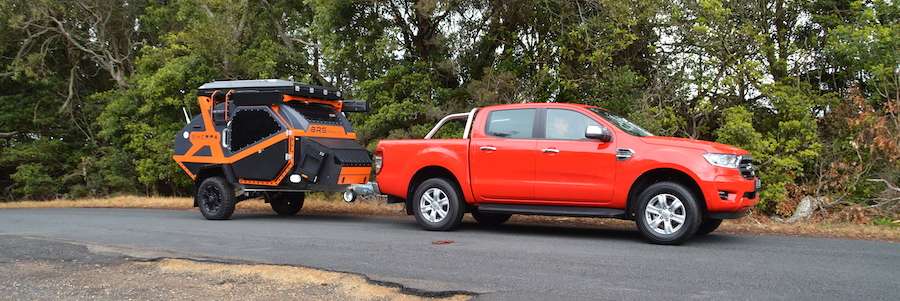
We evaluated the two different powertrains (five-cylinder, single-turbo 3.2-litre plus six-speed auto and four-cylinder, twin-turbo two-litre plus 10-speed auto) towing 1600kg Sherpa camper trailer and with 200kg payload in each vehicle. We used the same road, same driver and same climatic conditions – Southern Highlands NSW winter – to compare apples with apples.
It was immediately obvious that the multi-speed box behind the two-litre kept engine revs at a low level and with almost imperceptible shifts.
Progress over our undulating test course was smooth and the combination had no problem maintaining legal maximum road speeds, even on grades.
The only downside we could discern was virtually no engine braking on descents, even with the transmission flicked down manually to the lower gears.
Economy worked out at a creditable 11.9L/100km on the fuel flow meter, so, allowing for speedo error of five percent we reckon real-world economy towing this weight was 12.5L/100km.
We’ve read reports that say the two-litre/10-speed combo shifts gears too much… really! That’s precisely what it’s supposed do, to keep engine revs optimised and as constant as possible. Modern heavy trucks have 12-18-speed automated transmissions for exactly the same reason.
The five-cylinder engine had grunt similar to the two-litre’s, but with only six ratios in the box had more rise and fall in engine revs. As a result, it used more fuel, averaging 13.1L/100km on the fuel flow meter, or 13.8L/100km in the real world. Its larger displacement gave slightly more engine braking, but neither powerplant could match an old-fashioned 4.2-litre diesel’s downhill retardation.
A loss of engine braking power is common in all modern diesels that have small displacements, moderate compression ratios and high turbocharger boost.
Our conclusion was that the two-litre, twin-turbo with 10-speed box was a better towing powertrain, at least at the weight we evaluated.
On and off road – 2016 models
 Ford put on an excellent on and off road driving program for the release of the 2016 Ranger, athough the emphasis was on Double Cab and extended Super Cab models with automatic transmissions.
The chief program engineer for the Ranger upgrade program, Ian Foston, pointed out that his mission was to enhance the product, without departing in any way from its proved market strengths. His main target areas were in-cabin noise reduction and further suspension refinement.
Our first driving impressions indicate that he suceeded on both counts. The unladen test vehicles had well-controlled suspension action and flat handling. We checked out loaded behaviour in a five-ute comparison.
 The launch program did include a short tow test, with a ‘Dirty Harry’ Elite off-road caravan coupled to a Ranger Wildtrak. The Ranger 3.2 hauled the 2.5-tonnes van up a steep, gravel slope without any trouble an it cruised happily at legal speeds.
This particular caravan had a long drawbar that caused unnecessarily high ball weight, around 250kg and that sat the rear springs down on the helper leaves.
Ball weights around 100kg shouldn’t worry the new Ranger, but high ball weights will need compensation in the form of weight distribution bars.
The new model’s all-electric steering is lighter and quieter in action than the previous hydraulic power assisted system, but road feel is very good.
Our biggest complaint with the Ranger is the driver control design and layout. Some lunatic design engineer was been let loose redesigning things that didn’t need it. The switches and knobs are difficult to identify and awkward to use.
We found the auto gear selector a pain, although the new manual stick is much better to to operate.
Previous models
The prevous-shape, pre-2011 Ford Ranger had part of the required package for market share improvement, boasting the most potent four-cylinder diesel engine in the ute class.
However, it powered re-skinned bodywork that was tad on the small side and the chassis had a torsion-bar suspended front end that didn’t provide optimum handling in concert with an over-stiff set of rear leaves.
It wasn’t a bad package for a ute, but Ford knew that more would be required: more people space and cargo volume; more refinement, more performance and more presence.
As with the outgoing model the post-2011 Ranger was based around three cab styles: Single, Double Cab and Super (with forward-opening rear doors and no obstructive B-pillar).
All models were longer, wider and higher than before, with no carry-over components from the previous range. A new box-section ladder frame that was taller, wider and thicker than before mounted a double-wishbone, coil-sprung front end with rack and pinion steering.
An underslung rear axle design with bias-mounted shock absorbers continued, but with longer springs and stronger brackets and shackles. A brand new five-cylinder, turbo-intercooled diesel was developed and six-speed manual and automatic transmissions were offered.
 The 3.2-litre five-cylinder produced claimed maximum power of 147kW at 3000rpm, with peak torque of 470Nm in the 1750-2500rpm band. Claimed fuel consumption was 8.9L/100km.
A four-cylinder, 2.2-litre engine was available on the Single Cab manual transmission cab/chassis model.
Output was a claimed 110kW at 3700rpm, with peak torque of 375Nm at 1500-2500rpm.
More grunt, improved chassis dynamics and car-level electronic aids ensured that the new Ranger easily outperformed and out-handled its predecessor.
Standard kit included ABS with disc/drum EBD brakes; traction control; dynamic stability control; emergency brake assist and hill start assist; shift-on-the-fly 4WD selection; dial-selectable low range gearing; hill descent control and a lockable rear differential. The dynamic stability control system incorporated roll stability control, trailer sway control and adapted to suit different payloads.
Incidentally, drum rear brakes were retained because they provided a more powerful parking brake than the tiny drum-in-disc units fitted to 4WD wagons.
Three equipment levels were offered at launch: XL, XLT and Wildtrak.
 XL was far from being a ‘poverty pack’, with aircon; power windows and mirrors; remote central locking; Bluetooth; steering wheel cruise control and audio controls; trip computer; auto lights function; USB input; six speakers in all but Single Cabs and front and curtain airbags.
In March 2013 Ford introduced the XLS spec’ level – a tricked-up XL aimed at private and small business customers. The new addition to the Ranger lineup had a manufacturer’s list price of $48,090.
The XLS was based on the 4×4 XL Double Cab Pick-Up 3.2-litre model, with six-speed manual transmission and was intended to bridge the price gap between entry level XL and loaded XLT. The XLS came with locking rear differential, 16-inch alloy wheels, front foglights, carpeted floor and additional exterior trim highlights.
XLTs scored carpet; front fog lamps; dual-zone aircon; chromed side steps and rear step bumper; ambient temperature gauge; leather wrapped knob and steering wheel; locking rear diff; height and lumbar adjustable driver’s seat and tubular sports bar with high-mount stop light.
The Wildtrak was a Double Cab Ute model with XLT features plus leather seat trim, sports bars; satnav; rain-sensing wipers and an auto-dimming rear view mirror.
Ford received an NCAP rating of five stars for all variants.
The part-time 4WD system had an electronically controlled, two-speed transfer case.
A new chassis allowed a longer, 3220-millimetre wheelbase and wider track of 1560mm. Measuring 1549mm long, 511mm high and with a maximum cargo width of 1560mm, the cargo box of the double cab was more than 100mm wider than the pre-2011 model’s.
Width between the wheel arches was 1139mm on all ute models and there were ‘mezzanine-floor’ support pockets in the cargo box sides that allowed plywood or plaster board to be laid in flat sheets on a false floor.
Up front, the suspension was a new coil-over-strut, double wishbone suspension and rack and pinion steering is fitted. The back end has traditional ute leaf springs.
The brake system included Electronic Brakeforce Distribution and Emergency Brake Assist to provide maximum boost for the Anti-Lock Brake System (ABS). Flashing hazard lights automatically alerted following vehicles when an ABS stop was triggered.
All 2011 Ranger models had larger, 302mm front disc rotors with twin-piston callipers. Ford’s Electronic Stability Program (ESP) system that included four-wheel traction control, yaw control and roll-over mitigation was standard.
With Trailer Sway Mitigation the vehicle brakes were selectively applied to slow down and stabilise a ute/trailer combination.
On and off road
Our first drives in Rangers were done in some 2011 Australian launch vehicles, which were 3.2-litre XLT Double Cabs fitted with manual and automatic transmissions
Getting comfortable wasn’t a problem, thanks to the XLT’s adjustable driver’s seat and tilting steering wheel. However, some of the short-armed testers hankered for a telescopic column.
On bitumen and smooth gravel surfaces the Rangers rode and handled superbly, with noise levels that were almost car-like at cruising speeds. Only when the loud pedals were floored did engine noise intrude.
Rough surfaces stirred some leaf-spring reaction at the rear end, but the ride wasn’t harsh and dynamic stability and traction control preserved direction. We checked out gentle and emergency stopping power and were impressed with the Ranger’s pedal feel and stability under panic braking.
The six-speed auto was slick, with a manual override function that was easy to operate, once we adjusted to a forward movement for downshifts, not the more commonly used backward flick.
A light clutch with a vague friction point caught out some of the testers, but we found the manual gearbox very easy to use. That said, we preferred the auto, both on and off road. (The market subsequently had some reliability issues with the manual tranmsission an we suspect some of that had to do with abuse of the dual-mass flywheel fitted with the manual box.)
Steep, stony and dusty grades that were too steep to stand on proved to be no problem for the new Ranger that made a tidy job of conquering these quite demanding conditions. The 3.2-litre lugged happily down below 1000rpm, with no protest from engine or driveline.
The traction control system worked unobtrusively to control wheelspin and hill descent control was powerful, yet speed-variable by using the cruise control buttons.
The new Ford Ranger and its mechanically-similar Mazda BT-50 stable mate were obviously set for increased market share and such has proved to be the case.
2014 and 2015 upgrades
In April 2014 Ford introduced the Ranger 4×4 XL Plus series, in Single Cab Chassis, Double Cab Chassis and Double Cab Pick-up models. The manufacturer’s list price was $46,280 for the Single Cab Chassis, $51,760 for the Double Cab Chassis and $52,760 for the Double Cab Pick-up.
All came standard with Ford’s proven 3.2-litre turbo-diesel engine mated to a six-speed automatic transmission. This is a smart move by Ford, because by then the manual six-speed had come in for more than its fair share of criticism.
The Ranger 4×4 XL Plus was a purpose-built new vehicle with specifications and features that appealed to industry fleet buyers, including mining companies, government departments and organisations. The Ranger XL Plus also suited many OutbackTravel Australia site visitors.
Ranger 4×4 XL Plus standard features included: shields, mud flaps, 3,500kg tow bar, daytime running lights, running boards on Double Cabs, All-Terrain tyres (Continental 265/65 R17), canvas seat covers, expanded wiring harness and switch bezel, 80 amp-hour deep-cycle gel battery in a cargo-tray box, second battery isolator and moulded black bumpers. A steel ‘roo bar was optional and fitment didn’t affect a five-star NCAP safety rating.
Pre-2010 models
 Ford’s Courier, jointly mechanically-developed with Mazda, was given a fresh face for 1999 that aligned its appearance with that of the company’s US-built F-truck range. New wheel packages consisted of 16-inch on 4WD GL and 15-inch styled steel wheels with 235-section tyres on 4WD XL models.
Cabin space and appointments were improved on all models and a driver-side airbag option was introduced. The 2.5-litre Ford-Mazda intercooled turbo-diesel was then the most powerful diesel in a compact pickup, with 86kW at 3500rpm and 280Nm of torque at 2000rpm.
For 2003 the PG Courier received styling changes in the form of new grille, headlights, front bumper and front fenders. The top-of-the-range XLT models scored chrome on front and rear bumpers, door handles, tailgate handle and mirrors. A larger 265/70R15 tyre was standard on the 4WD XL and XLT vehicles.
Ford introduced a rear access system on the four-door Super Cab. Other new additions include optional two-tone exterior, two new colours – Amber and Spruce Green – and new alloy wheels. Inside, there were new fabrics, chrome door handles (XLT), an upgraded stereo system (with six-stack CD on XLT), engine immobiliser on crew cab turbo-diesel models and a keyless entry system. Ride quality was supposedly improved with revisions to the suspension componentry, but our testing showed little change to the harsh ride. However, twin-piston ventilated discs on the 4×4 XLT did improve fade resistance.
A new Super Cab 4×4 XLT was added to the range. Dual airbags and four-wheel ABS were optional on some 4×4 models. Pricing ranged from $28,890 for a 4WD Single Cab Chassis up to $42,560 for a 4WD diesel Super Cab Pickup XLT.
 In January 2005, Ford announced the Courier V6 option across Super Cab and Crew Cab body styles and in GL and XLT specification levels.
The 4.0-litre SOHC V6 engine produced a class-leading 154kW of power at 5250rpm and 323Nm of torque at 3000rpm.
On automatic 4WD V6 models there was a ‘Shift on the Fly’ selector switch mounted on the centre console, which enabled actuation of the transfer case for shifting between 4×2 and 4×4 modes (2WD-4WD-4WD Low).
The system worked in conjunction with an electronic remote front wheel hub lock. Recommended retail pricing was $43,190 for the top of the range automatic 4WD XLT Crew Cab.
In March 2007 Ford released the Ranger, with new bodywork and a new 3.0-litre, four-cylinder Duratorq diesel engine, with output of 115kW of power at 3200rpm and peak torque of 380Nm at 1800rpm.
A variable geometry turbocharger reduced turbo lag and broadened the torque curve. The new powerplant was matched with a five-speed manual or an optional five-speed automatic transmission. Ranger retained interior spaciousness and flexibility with a Single Cab, Crew Cab, Chassis Cab and the Super Cab, incorporating the innovative rear access system (RAS).
Ford Ranger’s more rigid chassis and tougher, more durable suspension may have improved strength and payload capacity, but ride quality continued to be a problem for the Ranger until the 2011 range was introduced. Pricing varied from $33,490 for a 4WD Single Cab Chassis XL up to $45,990 for a 4WD Crew Cab Pick Up XLT. Automatic transmission was a $2000 option.
The last upgrade of the first Ranger was in February 2009, with an exterior restyle that included a new $48,990 Wildtrak model.
Advertisements
