
Ford Ranger Super Duty
BUYERS GUIDE – UTES & CAB CHASSIS LARGE
FORD RANGER SUPER DUTY
This Ranger variant seems ready to fight with the big boys, but we raise some issues.
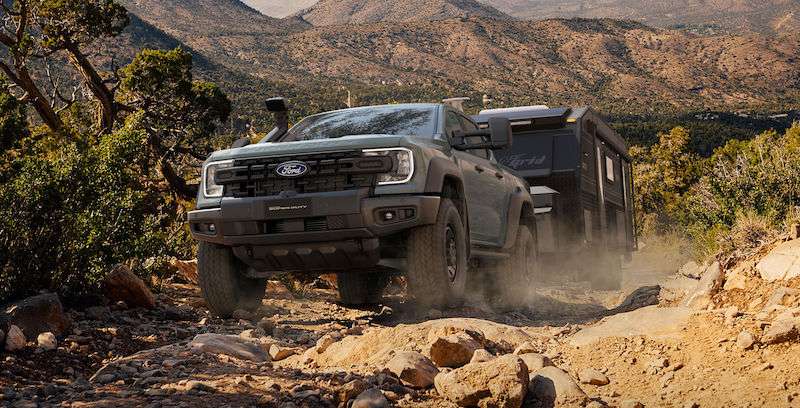
The Ford Ranger Super Duty was revealed in April 2025. Although based on the medium-sized Ranger, the Super Duty has sufficient upgrades to warrant its listing in this Large Utes section of the OTA Buyers Guide.

This Ranger derivative is aimed at hard-core buyers and heavy-trailer towers. We’re sure it will challenge US-made utes, including Ford’s own F-150 and also Toyota’s 70-Series LandCruiser.
“We listened to what the hardest working fleet operators told us they needed to be more productive and we’ve developed a Ranger with heavy-duty hardware and enhanced capability,” said Jim Baumbick, vice president, advanced product development, cycle planning and programs, Ford Motor Company.
“We are taking global mid-size truck capability to a whole new level, straight from the factory.”
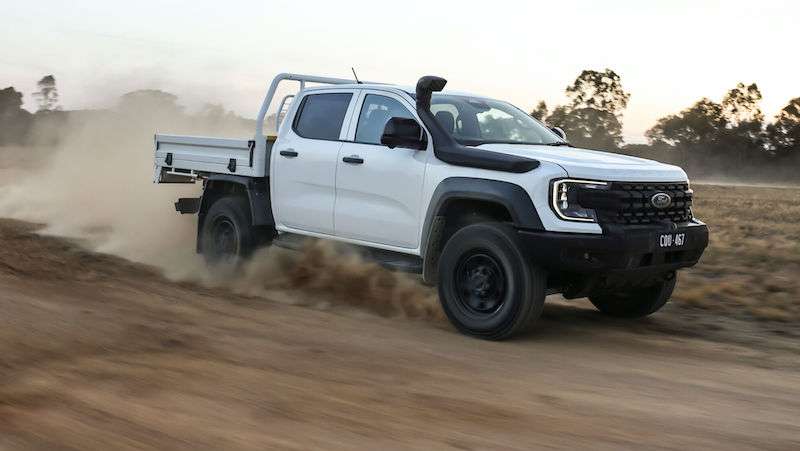
Available in Australia as either a Single, Super or Double Cab Chassis from its planned launch in early 2026, Ranger Super Duty will also be available as a Double Cab with style-side box in mid-2026.
Ranger Super Duty will be available in two trim levels: Ranger Super Duty and Ranger Super Duty XLT (arriving mid-2026). This variant will have alloy wheels and touring-focussed upgrades and will be exclusively available on Double Cab chassis and pick-up variants only.
Redefining the heavy-duty, mid-size ute segment, Ranger Super Duty will be available with Integrated Device Mounting System, on-board scales, sealed snorkel, front and rear differential locks, and heavy-duty axles, suspension and chassis.
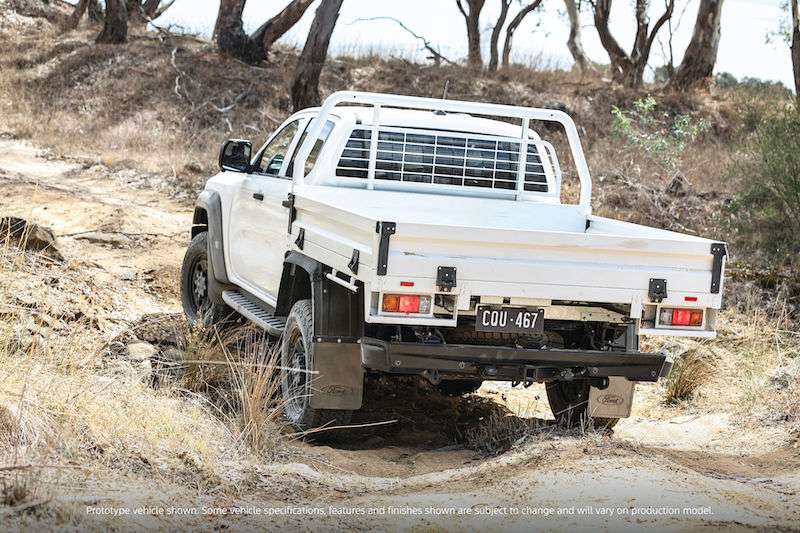
Part of the Ranger Super Duty’s durability testing was a ‘mud-pack’ test to simulate mine work. The test ute was said to have continued working, even with 600 kilograms of mud stuck to its underside.
The ute also ran the usual durability tests, including 24/7 corrosion baths, towing dynos, shaker-rig testing, extreme real-world off-roading and low-speed, low-range, heavy-load driving.
Being able to tow 4500kg – one tonne more than any other factory-built mid-size ute – the Super Duty scored a recalibrated integrated trailer brake controller and the latest Ranger Pro-Trailer Backup Assist, with a yaw-rate sensor, to help automatically manage trailer angle.

Ranger Super Duty also debuts Ford’s Smart Hitch and Onboard Scales for the first time on a Ranger. Smart Hitch was designed to help customers adjust trailer load, to ensure optimum load distribution and avoid under- or over-loading the towball.
Sensors mounted in the suspension on all four wheels allow the Onboard Scales technology to monitor payload and axle weights in real time, displaying loading on the SYNC screen.
A 130-litre, long-range fuel tank is standard, with steel shielding to protect the tank from damage.
The engine, front differential and transfer case and transmission are also shielded.
Although its chassis dimensions are the same as the Ranger’s, the Super Duty has a unique frame, engineered to provide increased strength and load carrying capacity. The frame material is thicker and suspension mounts, body-mount brackets and towbar mounts have been reinforced. The result is a 4500-kilogram GVM rating.
Ranger Super Duty also has stronger front and rear driveshafts, a heavy-duty rear axle and eight-stud wheel hubs.
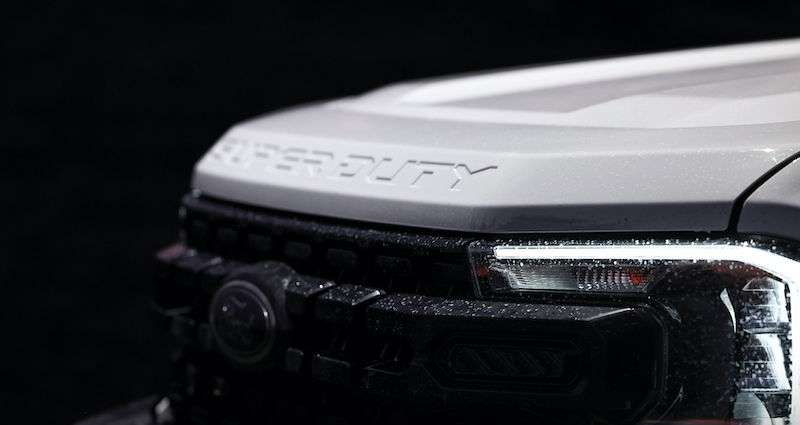
Under Ranger Super Duty’s reshaped bonnet is Ford’s 3.0-litre, turbo-diesel V6; re-calibrated for more lenient, heavy-duty emissions standards. Ranger Super Duty also offers customers the option of delaying the automatic diesel particulate filter (DPF) regeneration and then manually initiating the clean at a time that suits.
Improved cooling is said to ensure optimum temperature management under load and during sustained off-roading in difficult terrain.
Knowing Ranger Super Duty will be driven in extreme locations, engineers ensured differential, transmission, fuel and transfer case breathers were all high-mounted, improving wading depth.
Ranger Super Duty offers six selectable drive modes: Normal, Eco, Tow/Haul, Mud/Ruts, Sand and Rock Crawl. These modes tailor a range of vehicle settings, from throttle and transmission response to stability control.
Equipped with Ford’s advanced four-wheel drive system, Ranger Super Duty comes with 4A (Automatic 4WD) as the permanent setting, for optimal grip on all surfaces. The two-speed transfer case features larger, stronger components than other Ranger variants.
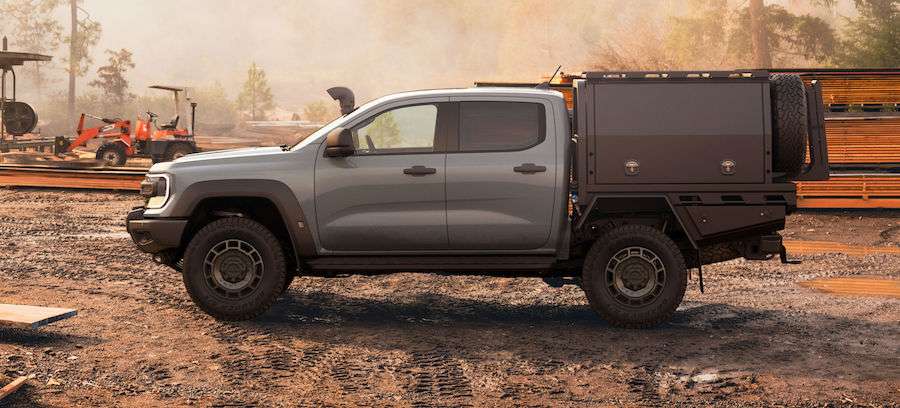
At OTA we welcome Ford’s initiative to toughen up the Ranger platform for typical Aussie duties, but we’re surprised that the company didn’t opt for a longer wheelbase option, in conjunction with the stronger frame and axles.
The longer wheelbase Double-Cab was certainly evaluated in the USA, as you can see by reading our Ranger entry in the Medium Utes section of this website.
We concerned that the current-wheelbase Super Duty won’t be able to handle both its raised GVM and GCM figures without some serious axle-weight imbalance issues.

We think the Double-Cab will be a heavy-towing ute, not a heavy-payload ute, because the its wheelbase is simply too short. The Super-Cab may be able to do both and the Single-Cab certainly will.
At the Super Duty’s 8000kg GCM rating, we also have some durability concerns about the V6 diesel that was derived from the old Peugeot-Ford 2.7-litre Land Rover diesel and we hope they’ve done lots of long-term, heavy-towing testing of the 10-speed Ford auto transmission.
The Super Duty’s engine calibration was designed to meet EUVI heavy-duty vehicle emissions requirements, including selective catalytic reduction (SCR) exhaust treatment that needs AdBlue fluid. Crucially, this calibration retains the V6 engine’s 154kW of power at 3250rpm and 600Nm of torque at 1750rpm.
The upgraded cooling system is 25-percent more efficient than the existing Ranger’s.
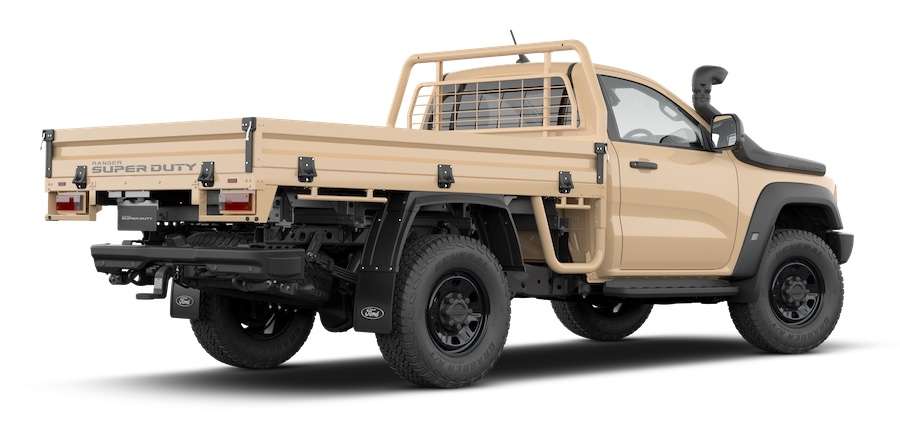
In June, 2025 Ford Australia announced the highly anticipated price and specification details of the 2026 Ranger Super Duty Cab-Chassis variants: Single Cab-Chassis from $82,990 MLP; Super Cab-Chassis from $86,490 and Double Cab-Chassis from $89,990.
Added to those figures can be dealer-fit, Ford Licensed Accessory steel trays in a choice of galvanised silver, body colour and matte black, in the price range from six grand to $9400.
Also announced were impressive payload ratings: Single Cab-Chassis, up to 1982kg; Super Cab-Chassis, up to 1896kg and Double Cab-Chassis, up to 1825kg. These impressive payload figures were made possible by markedly higher Gross Axle Weight Ratings (GAWR): 1900kg for the front axle and 2800kg for the rear axle.
Ford enlarged the footprint of the Super Duty model with an axle-track width of 1710mm, as well as increasing ground clearance to 295-299mm and providing wading depth of 850mm.
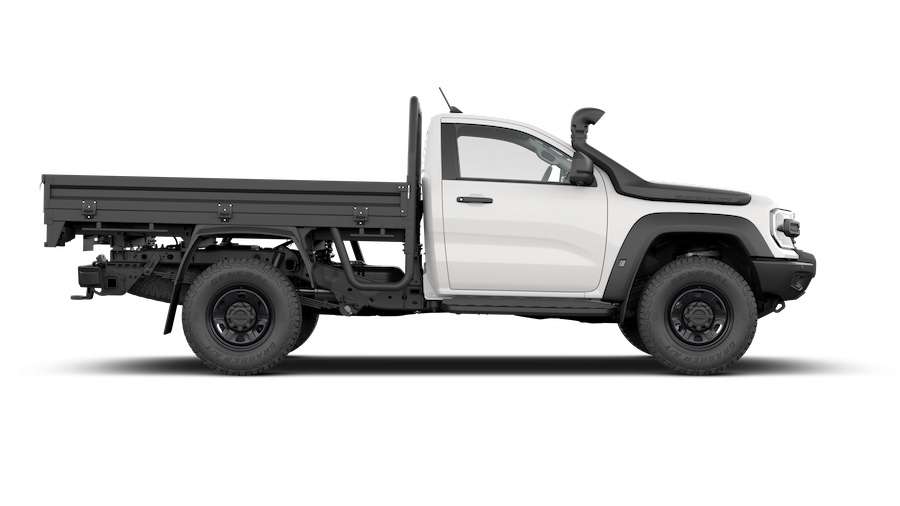
At launch, Ranger Super Duty will be available in Seismic Tan, Arctic White and Shadow Black. Traction Green will be available later in 2026, aligning with the launch of Double-Cab Pickup and XLT variants.
We’ll await 2026 test vehicles to check them out in the real world. We’ll also check their warranty conditions for heavy-duty work.
Ordering for Ranger Super Duty in Australia and New Zealand opens later this year with arrivals in dealerships expected in 2026. More information is available at ford.com.au
Advertisements
